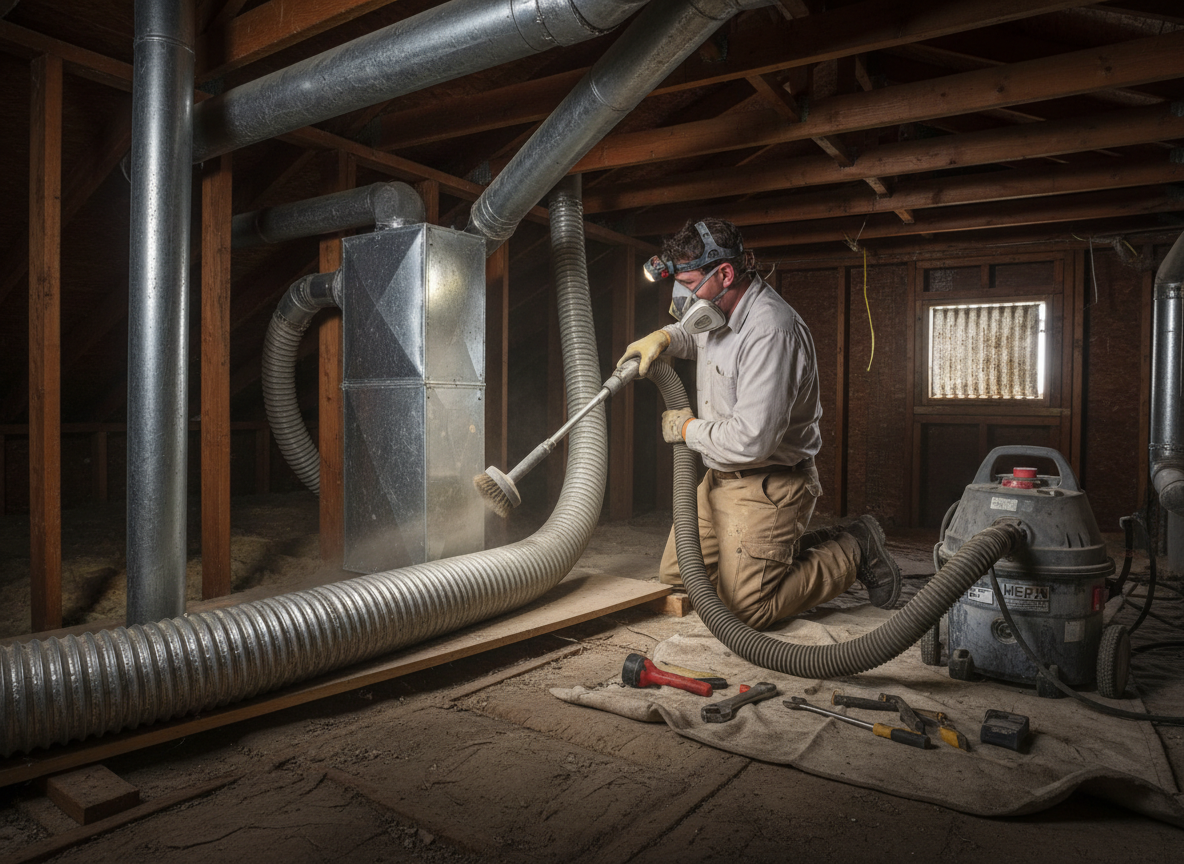
Attic duct systems in Camp Verde homes often sit above minimal insulation in houses built decades ago near Fort Verde State Historic Park. High desert days that reach the 90s followed by cool nights cause repeated expansion and contraction that loosens joints and lets fine red dust migrate into the ducts from unsealed attic spaces. Technicians must work around low-clearance rafters and knob-and-tube wiring common in Middle Verde properties while using negative-air machines to keep debris from falling into living areas below.
Access points in these older Yavapai County homes are frequently limited to small scuttle holes or pull-down ladders that do not accommodate full-sized equipment. Flexible duct runs installed in the 1980s and 1990s sag between joists and trap dust at every low spot, requiring section-by-section agitation and vacuuming rather than a single pass. Crews also check for rodent nesting material that accumulates during the cooler months when animals seek warmth in attics between Camp Verde and Cottonwood.
After cleaning, seams are resealed with mastic rather than tape because the daily temperature swings here quickly degrade foil tape. Homeowners near Sedona often request the service before monsoon season when wind-driven dust increases. The work takes longer in two-story homes where ducts run through finished ceilings, and every register must be removed and cleaned individually to prevent re-contamination once the system restarts.
Technician insight
In Camp Verde, the thing that catches most people out with attic duct cleaning is how quickly fine red dust from the high desert settles back into ducts through unsealed attic bypasses in older homes near Fort Verde, especially after the temperature swings loosen every joint.
Middle Verde Attic Dust Load
Homeowner in Middle Verde reported weak airflow and allergy flare-ups. Inspection showed heavy dust accumulation in sagging flex ducts caused by daily temperature swings and open attic bypasses. Crews agitated and vacuumed each run under negative pressure, resealed joints with mastic, and restored airflow without disturbing the limited insulation.
How it works
- 1
Attic Access and Safety Setup
Technicians locate entry points, lay protective flooring, and establish negative pressure to contain dust before any work begins.
- 2
Visual Inspection and Mapping
Ducts are examined for sags, disconnected sections, and nesting material common in Camp Verde attics, with findings noted for the homeowner.
- 3
Agitation and Vacuum Removal
Each run is agitated with brushes sized for the duct diameter while a HEPA vacuum pulls debris from the system.
- 4
Sealing and Final Check
Joints are sealed with mastic, registers are reinstalled, and airflow is tested at multiple points before equipment is removed.
Pricing
Pricing varies with attic access difficulty, duct length, and amount of debris typical in high desert homes.