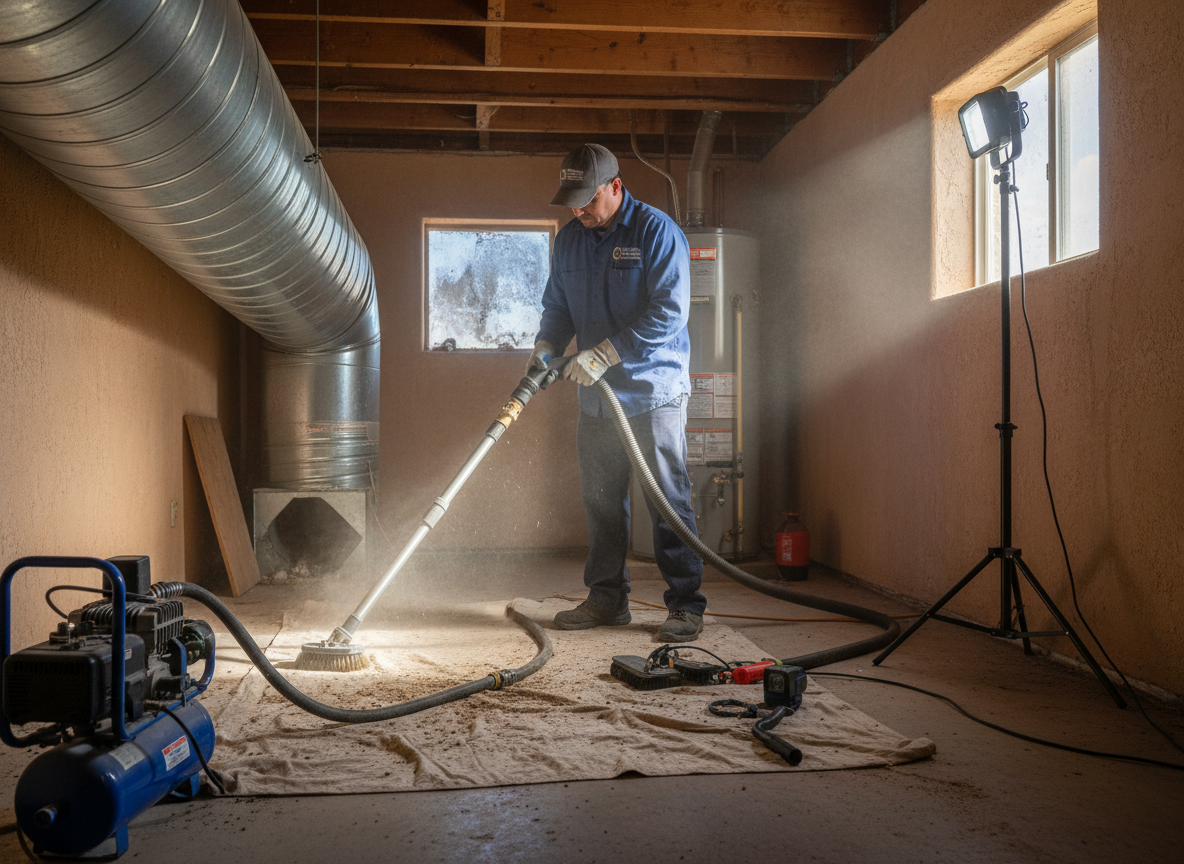
Camp Verde sits in Yavapai County high desert where warm days and cool nights drive daily temperature swings that push fine red dust through every seam in ductwork. Homes near Fort Verde State Historic Park and along the Middle Verde corridor often date to the 1960s or earlier, with original flex duct and unsealed joints that trap pollen and grit from the surrounding terrain. Standard household vacuums cannot reach these lines, so settled material recirculates every time the system cycles, especially during the long shoulder seasons when residents run heat at night and cooling in the afternoon.
Montezuma Castle National Monument draws heavy visitor traffic that stirs additional airborne particles into the local air shed, and those same particles settle inside nearby residential trunks. Older ranch-style houses in Camp Verde frequently have trunk lines routed through low crawlspaces with rocky soil that holds moisture after monsoon rains, creating spots where mold can begin on dust layers. Technicians must disassemble sections carefully to avoid collapsing aged duct board while still removing the compacted material that restricts airflow more than visible debris.
Service calls between Camp Verde and Cottonwood often reveal blocked return plenums where homeowners have added insulation without sealing the duct seams first. This traps the fine silt that blows in from Sedona’s red rock country during spring winds. Proper cleaning requires negative-air machines staged outside to keep loosened particles from re-entering living spaces, followed by a full register and boot inspection that accounts for the low ceilings common in these older Yavapai homes.
Technician insight
In Camp Verde the thing that catches most people out with Residential Air Duct Cleaning is the fine silt that packs into low crawlspace ducts after monsoon runoff; the rocky Yavapai soil holds just enough moisture to turn that dust into a concrete-like layer that standard brushes skip over unless you hit it with compressed air first.
Middle Verde Crawlspace Blockage
Homeowner noticed weak airflow and musty odor after a week of cool nights. Inspection found collapsed flex duct resting on damp soil near the Fort Verde area. We replaced the damaged section, extracted packed silt from the remaining trunk, and restored full airflow without disturbing the original plaster walls.
How it works
- 1
Initial Walk-Through
Technician inspects every accessible run, notes duct material, and checks for moisture stains or collapsed sections typical in Middle Verde crawlspaces.
- 2
Negative-Air Setup
Equipment is staged outside the home to pull dust away from living areas while registers are sealed one at a time.
- 3
Agitation and Extraction
Rotating brushes and compressed air move debris from trunk lines and branches toward the vacuum collection point.
- 4
Register and Boot Cleaning
All vents and boots are removed, cleaned, and reinstalled to prevent immediate re-soiling from residual dust.
- 5
Final Airflow Check
System is run and static pressure is measured to confirm improved flow before leaving the property.
Pricing
Cost depends on number of runs, access difficulty in crawlspaces, and whether older flex duct needs section replacement.