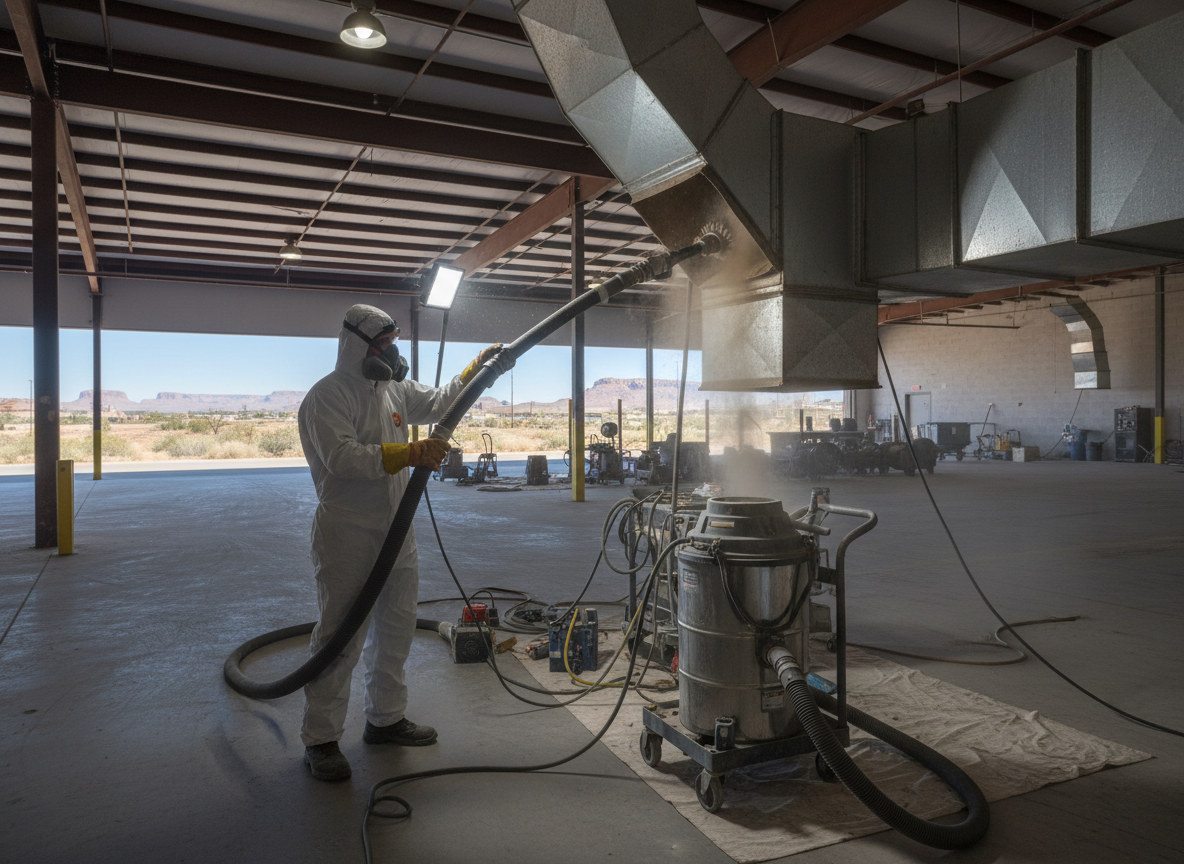
Industrial facilities around Camp Verde and Middle Verde often sit in structures built decades ago near Fort Verde State Historic Park or along routes to Montezuma Castle National Monument. These buildings collect fine silt carried by high desert winds that settles deep in large-diameter duct runs serving manufacturing or processing areas. The daily swing from warm afternoons to cool nights causes metal ducts to expand and contract, loosening accumulated debris and pushing it into occupied spaces or sensitive equipment zones.
Technicians must account for Yavapai County soil conditions and the proximity of the Verde River when setting up containment. Negative-air machines need careful placement to avoid pulling river humidity into the system while still capturing the dry, abrasive dust that accelerates filter loading. Access panels in older industrial roofs and walls are frequently undersized, requiring sectional equipment and longer run times than standard commercial jobs in nearby Cottonwood or Sedona.
Code considerations include maintaining separation between process exhaust and general HVAC to prevent cross-contamination during cleaning. In high desert climates, static pressure testing after service confirms that seals have not been compromised by repeated thermal cycling. Work is scheduled around production cycles because shutting down large fans for extended periods affects temperature control in facilities that run continuously.
Technician insight
In Camp Verde, the thing that catches most people out with Industrial air duct cleaning is how the fine silt from surrounding high desert terrain infiltrates older metal ducts in buildings near the river; the daily temperature swing loosens it overnight so a standard residential-style vacuum job just redistributes the dust instead of removing it.
Processing Plant Near Middle Verde
A manufacturing facility reported uneven airflow and visible dust on product surfaces. Inspection showed compacted silt blocking main trunk lines that had expanded and contracted with nightly temperature drops. Crews set up oversized negative-air units, agitated the full run length, and extracted the load. Airflow returned to design levels and product contamination dropped immediately.
How it works
- 1
Site Assessment
Map all trunk lines, branches, and access points in the industrial system while noting roof penetrations and equipment locations typical of Camp Verde commercial buildings.
- 2
Containment Setup
Install negative-air machines and sealed barriers sized for the volume of larger ducts, accounting for wind-driven silt common in the high desert around Middle Verde.
- 3
Mechanical Agitation and Extraction
Use rotary brushes and compressed-air whips followed by HEPA vacuum extraction to remove compacted desert dust without damaging older duct seams.
- 4
Post-Cleaning Verification
Perform static pressure and airflow checks, then restore normal operation while documenting any repairs needed due to thermal expansion in Yavapai County buildings.
Pricing
Pricing depends on duct diameter, total linear footage, number of access points required, and whether production shutdowns are needed.